
If you search for the best AI video creation tools, you quickly run into the same problem found in most software roundups: different products get compared as if they solve the same job.
That breaks down fast in short-form video.
Some tools are built to turn ideas into finished social clips with almost no manual editing. Some are better when you want faceless automation. Others are closer to general AI video generation and are more flexible than social-first.
Those are not the same workflow.
This guide compares three tools from IndieAI’s current directory that genuinely belong in the same wider decision set:
They are all relevant to AI video creation, but they serve different types of builders and creators.
What Actually Matters in AI Video Creation Tools
The most useful way to evaluate this category is not by asking which product has the longest feature list. It is by asking which one shortens the path between idea and publishable clip.
For most creators and marketers, the real evaluation criteria are:
- how much manual editing is still required,
- whether the tool is optimized for social platforms,
- whether the workflow is better for faceless content or broader video creation,
- and how much control you want over the final output.
Once you look at the category this way, the differences between the tools become clearer.
1. Revid AI for Fast Social Content Production
Revid AI is the strongest fit if your main goal is to produce more short-form social content with less manual work.

It is built around the reality of TikTok, Reels, and Shorts workflows:
- fast ideation,
- automated scripting,
- voiceovers,
- branded editing,
- and publishing-ready output.
That makes it especially useful for creators, agencies, and founders who want a repeatable social content engine rather than a flexible experimental video lab.
Its biggest strength is operational speed. It helps compress multiple steps of a social content workflow into one system, which is exactly what high-volume teams usually care about.
Best for
- Creators publishing frequent short-form content
- Agencies managing recurring social video output
- Founders who want fast content production without heavy editing
Strengths
- Strong all-in-one workflow for scripting, editing, and publishing
- Well aligned with Shorts, Reels, and TikTok production
- Good fit when speed matters more than deep manual control
Not ideal for
- Users who mainly want faceless-channel automation
- Builders who want a more flexible text-to-video playground
2. StoryShort for Faceless and Automated Video Channels
StoryShort is a better fit when the workflow centers on faceless videos and automated publishing.

That makes it especially relevant for:
- YouTube Shorts operators,
- creators building faceless channels,
- and marketers who care more about volume and consistency than highly customized cinematic output.
Compared with Revid AI, it is more obviously positioned around the faceless-video model. That is useful if your content strategy depends on repeatable template-driven production rather than a broader creator-brand workflow.
Best for
- Operators of faceless YouTube Shorts channels
- Teams that care about repeatable, template-like production
- Marketers prioritizing volume over custom polish
Strengths
- Clear fit for faceless and automated video workflows
- Useful for repeatable, systematized publishing
- Narrower positioning makes buyer fit easier to judge
Not ideal for
- Teams wanting a broader social content engine
- Users who need more open-ended AI video experimentation
3. LTX 2.3 AI for Flexible AI Video Generation
LTX 2.3 AI belongs in this guide because some users want more than a social clip factory.
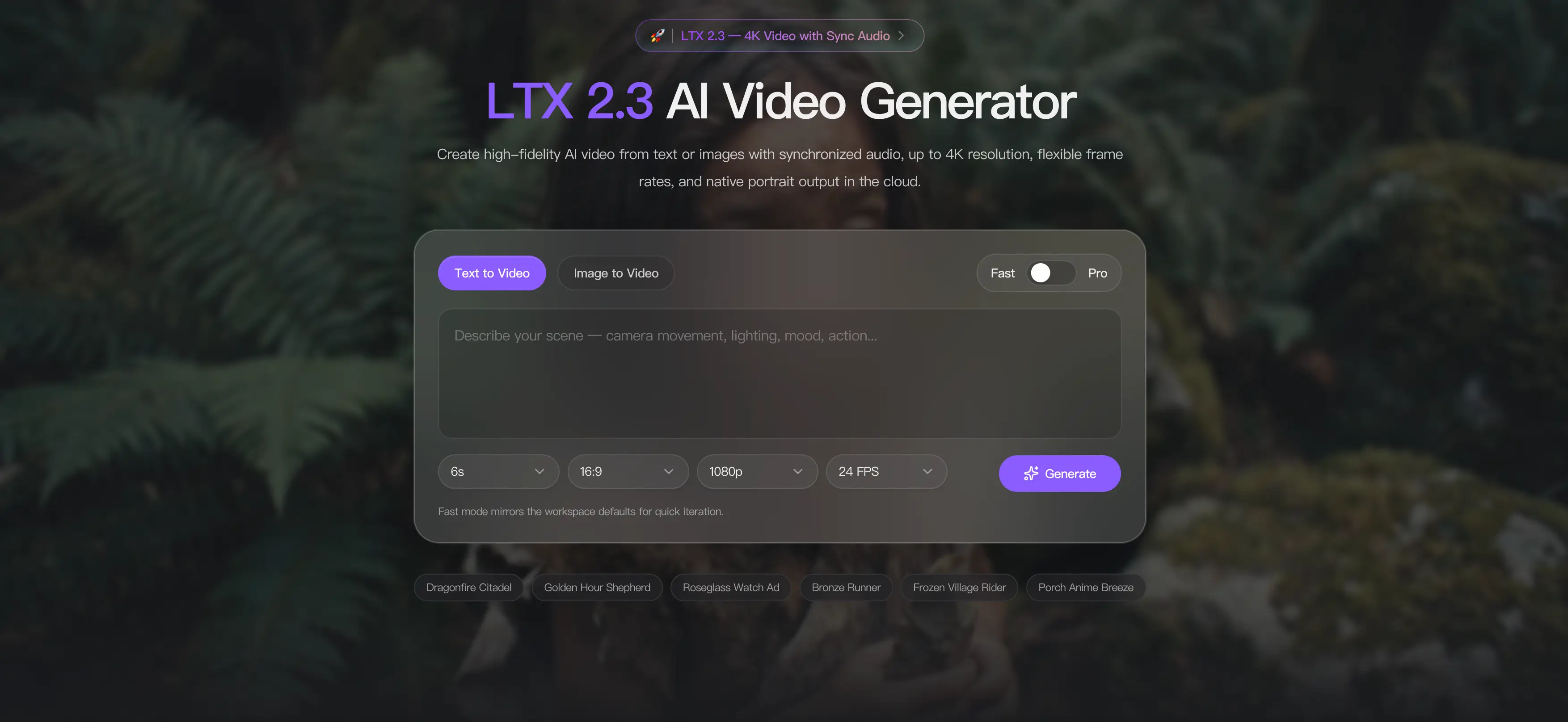
Its value is higher when you want:
- text-to-video,
- image-to-video,
- higher output flexibility,
- and more model-oriented control.
It is less social-native than Revid AI and less faceless-workflow-specific than StoryShort, but more open-ended for users who want AI video generation as a capability rather than only as a content pipeline.
That makes it the best fit of the three for builders and creators who still want room to experiment.
Best for
- Builders exploring text-to-video and image-to-video workflows
- Creators who want more flexibility than social-first video tools
- Users who care about generation capability as much as publishing speed
Strengths
- Broader AI video generation flexibility
- Better fit for experimentation and model-driven workflows
- Useful when the output is not limited to standard short-form content pipelines
Not ideal for
- Teams mainly optimizing a fast social publishing workflow
- Users who want the most guided, operations-first short-form tool
Which Tool Should You Actually Pick?
Use this shortcut:
- Choose Revid AI if you want the strongest all-in-one workflow for short-form social content production.
- Choose StoryShort if you want a more faceless-video-focused workflow.
- Choose LTX 2.3 AI if you want broader AI video generation flexibility.
If your main objective is publishing more short-form content with the least possible operational overhead, Revid AI is the strongest recommendation in this set.