

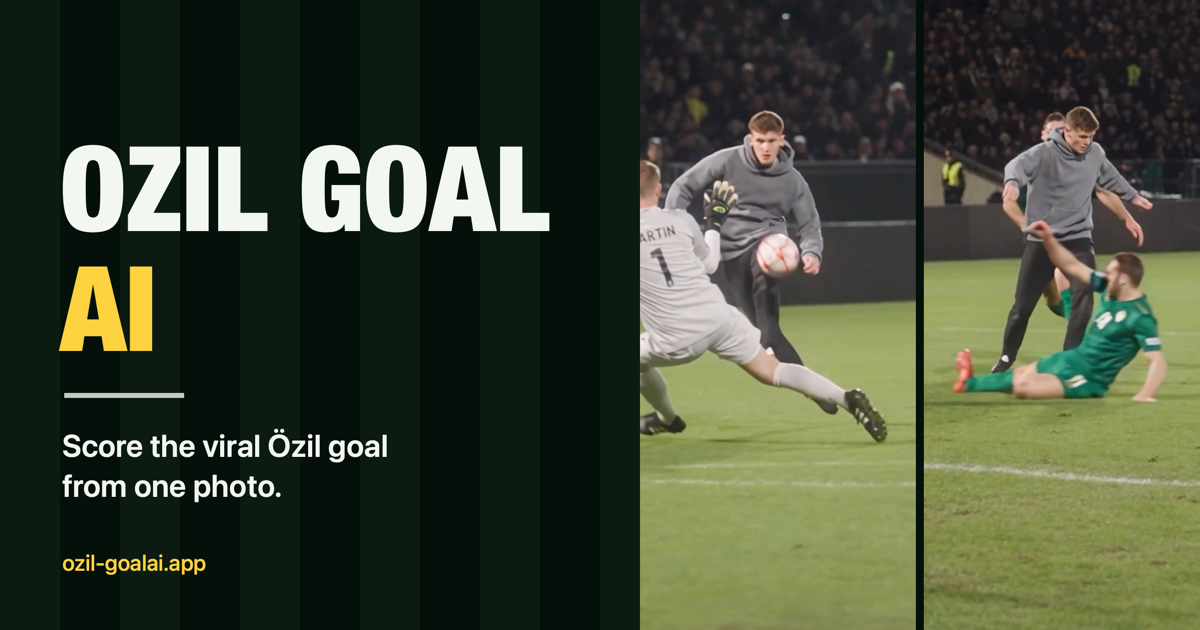
Ozil Goal AI puts you in the football clip that went viral in October 2026: a remake of Mesut Özil’s late winner for Arsenal at Ludogorets in 2016, with someone else in his place. Under the floodlights you run onto the ball, chip the onrushing keeper, let two sliding defenders go past and roll it into the empty net.
Every video follows the same 14 seconds. Your photo becomes the scorer, wearing what you wore in the photo. The camera, the stadium, the defenders and the sound stay the same. There’s no prompt to write, no timing to match and no editing app. You upload a photo and the AI renders the whole clip.
Key Features
- One photo, no prompt. The chip, the two slide tackles and the finish are built in.
- Your face, your clothes. The scorer wears what you’re wearing in the photo.
- Sound included. The trend soundtrack is timed to the goal.
- Vertical MP4, up to 1080p. 9:16 for TikTok, Reels and Shorts, with no watermark.
- Background rendering. Close the tab. Finished videos wait under “My videos” for 14 days.
- Failed videos refunded. Credits come back automatically if a render fails.
Pricing
One-time credit packs, no subscription. Credits last 12 months. A video costs 100 credits at 480p, 200 at 720p or 600 at 1080p.
- Single: $9.90 for 100 credits (1 standard video).
- Starter: $19.90 for 300 credits (3 standard videos). Marked most popular.
- Creator: $49.90 for 900 credits (1 Full HD video or 9 standard).
- Pro: $89.90 for 1800 credits (3 Full HD videos or 18 standard).
Who It’s For
Football fans and TikTok users who want their own version of the Özil goal trend, and anyone who wants to drop a friend or a parent into the clip as the scorer, with their permission.
How It Works
- Add your photo. One person, head to waist or full body, face clearly visible.
- Pick a quality and press Generate. Standard, HD or Full HD. Rendering takes a few minutes.
- Download and post. Save the MP4 and turn on the AI-generated content label when you post.
The AI redraws your face while you sprint, jump and turn, so a sharp, well-lit photo taken at eye level gives the closest likeness. Group shots, sunglasses and heavy filters make the face drift.